
Google & AI Local Ranking Factors: How to Win Local Search in 2026
The New Reality of Local Search in 2026
Local businesses in 2026 face a transformed landscape where AI Overviews appear in over 70% of searches and tools like ChatGPT or Perplexity deliver instant recommendations. Classic tactics such as Google Business Profile optimization and backlinks remain important, but success now demands blending them with AI-savvy strategies that position your business as the clear top choice in generated answers.
Key Local Ranking Factors in 2026
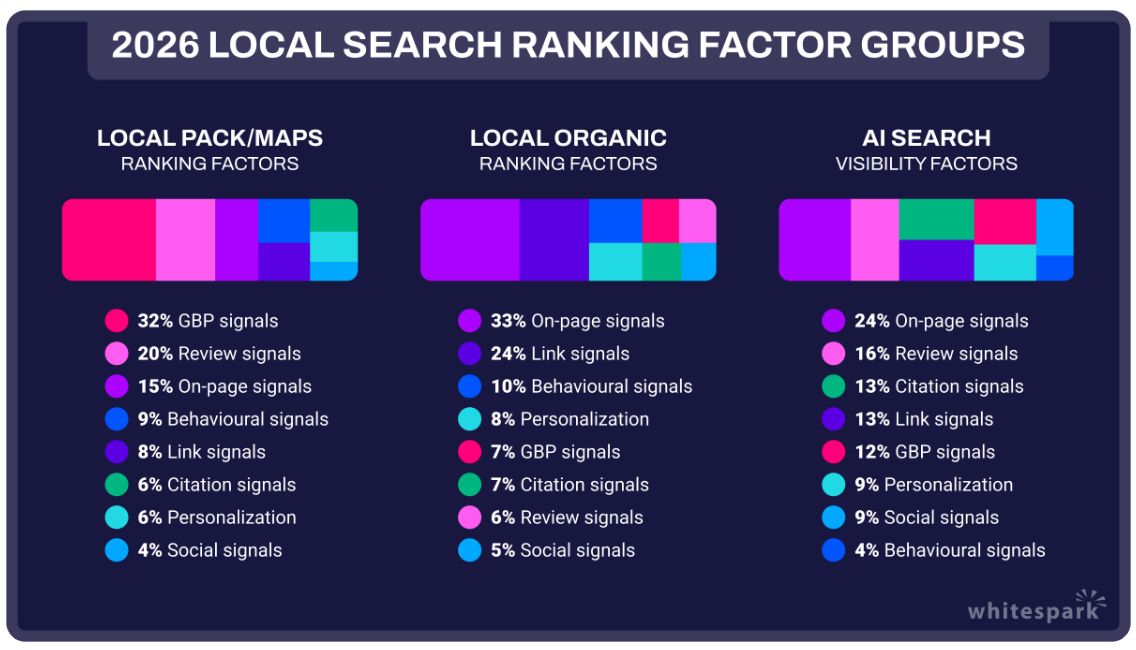
Experts agree that certain signals dominate both traditional local packs and AI responses. Drawing from Whitespark’s 2026 Local Search Ranking Factors report, BrightLocal insights, Neil Patel’s LLM analysis, and Uberall data, these weighted factors provide a practical roadmap for visibility across all platforms.
Google Business Profile Optimization (32% Weight)
Complete every section of your GBP with precision, including primary and secondary categories, detailed services, geo-tagged photos, regular posts, and accurate hours. This digital storefront remains the strongest single signal for both local packs and AI selections.
Customer Reviews as Power Players (20% Weight)
Prioritize volume, quality, recency, and positive sentiment while weaving in relevant keywords. Respond to every review promptly and maintain authenticity across Google, Yelp, Facebook, and other sites—AI tools actively scan these for trustworthiness.
On-Page Optimization and Schema Markup (15% Weight)
Build hyperlocal content on service and location pages while adding structured data markup. This combination helps search engines and AI systems quickly understand and cite your business.
Behavioral and Engagement Signals (13% Weight)
Drive clicks, longer dwell times, direction requests, and conversions through fast-loading sites and clear calls to action. These real-user interactions signal to both Google and AI that your business is popular and reliable.
NAP Consistency and Online Trust
Keep your name, address, phone number, website, hours, and descriptions identical everywhere online. Even small discrepancies make AI hesitate to recommend you, undermining credibility across the board.
Hyperlocal Content for Intent Matching
Create pages and posts that directly answer natural queries such as “Best roofer for Massachusetts winters” or “Car accident lawyer with 5-star reviews in Dedham, MA.” This alignment with real user intent boosts both traditional rankings and AI citations.
Earning Mentions and “Best Of” Features
Secure features in local news, “best of” lists, and industry blogs. These unstructured mentions carry extra weight in AI responses because they demonstrate genuine prominence beyond standard directories.
Traditional Local SEO Tactics That Remain Essential
Core local SEO principles have not disappeared-they have simply become more competitive. Google’s algorithm continues to evaluate relevance, proximity, and prominence, with on-the-ground signals still carrying heavy influence according to expert consensus.
The Core Pillars (Relevance, Proximity, Prominence)
Match search terms precisely, appear close to the searcher’s location (especially for “near me” queries), and build overall reputation through reviews and citations. These timeless foundations underpin every successful local strategy.
Mastering GBP and On-Page Elements
Treat your Google Business Profile as your primary digital storefront by optimizing categories, services, and photos while keeping on-page titles, headings, and content keyword-focused without stuffing. Proximity personalization based on user history further refines results.
Leveraging Reviews and Citations
Focus on steady review velocity, detailed text, and photo-rich entries. High-quality citations from local directories and authoritative backlinks strengthen prominence, but always prioritize quality over sheer quantity.
How AI is Reshaping Local Search and Recommendations
Google and large language models no longer simply rank pages-they synthesize answers and recommendations from your entire online footprint. Users now ask conversational questions, forcing businesses to think beyond keywords.
Focus on E-E-A-T and Consistency
Demonstrate Experience, Expertise, Authoritativeness, and Trustworthiness through detailed bios, case studies, and community involvement. Consistent NAP data and clear descriptions across every platform give AI the confidence to recommend you.
From Rankings to Recommendations
AI often returns shortlists, pros-and-cons breakdowns, or a single top pick rather than long link lists. It cross-checks sources for consensus, so any inconsistency or lack of proof dramatically reduces your chances of being featured.
Blended Core Ranking Factors for SEO and AI Success
The most effective approach merges traditional pillars with AI requirements into four unified factors that work across both environments.
Relevance – Matching User Queries
Align GBP categories, services, and dedicated location pages with exact search intent. For AI, emphasize urgency, hyperlocal context, and even multilingual support to match full-sentence questions.
Prominence – Building Reputation
Accumulate diverse reviews, press mentions, and “best of” features. AI places extra value on unstructured citations in blogs and news because they signal authentic recognition.
Trust and Entity Strength
Maintain flawless Name, Address, Website consistency, identical descriptions, real photos, project examples, and comprehensive schema markup. Adding credentials and ownership details further strengthens E-E-A-T signals that AI loves.
User Engagement and Behavioral Signals
Optimize for clicks, dwell time, mobile speed, and interactive GBP elements like videos. These metrics tell both Google and AI that visitors genuinely love and trust your business.
Practical Strategies to Optimize Beyond the Basics
Traditional tactics establish presence; AI tactics establish credibility and clarity. Use this checklist to move ahead of competitors in both traditional rankings and AI-generated answers.
Supercharge Your Google Business Profile
Post weekly updates, upload fresh photos and videos, and answer common questions in a conversational tone that mirrors how people query AI tools. Make booking and payments easy for AI agents. If your business takes appointments use tools like Calendly (for booking times), OpenTable (for reservations), Square, or Stripe (for payments). Some platforms support full booking or payment in one quick step. See list below:
- Claim and Fully Complete Your Google Business Profile
- Add High-Quality Photos, Videos and Regular Posts
- Create Special Posts for Offers and Promotions
- List Events to Boost Local Visibility
- Setup Online Booking and Payments
- Add Products and Detailed Services
- Enable Messaging
Build Authentic and Detailed Reviews
Encourage customers to share specific stories mentioning services and locations. Respond to every review and diversify across platforms to strengthen sentiment signals.
Chase Unstructured Mentions
Go beyond directory listings by pitching for local news features, event coverage, and “best of” lists-these carry significant weight in AI recommendations.
Implement Comprehensive Schema Markup
Add LocalBusiness, Service, Review, Area of Service and FAQ schema to every relevant page. This structured data makes your information instantly machine-readable for AI overviews.
Create Hyperlocal, AI-Friendly Content
Write scannable pages with short paragraphs, bullets, and FAQs on timely topics such as “2026 Roof Replacement Costs in MA” or “What to Expect at Your First Chiropractor Visit.” Tie content to local weather, regulations, and culture.
Prove Expertise with Supporting Assets
Publish case studies, before-and-after galleries, transparent pricing guides, and comparison articles. These proof elements give AI concrete reasons to cite you as the expert choice.
Dominate Multiple Platforms
Maintain consistent profiles on Apple Maps, social channels, and industry directories. Tools that track entity recognition help ensure AI sees you as a unified, trustworthy brand.
Monitor AI-Specific Metrics
Shift focus from pure rankings to Search Console impressions, AI tool referrals, and branded search growth. Regularly test real queries in Google Overviews and other LLMs to identify and close visibility gaps.
Traditional tactics deliver presence and relevance; AI tactics deliver credibility, clarity, and consensus. When the entire web agrees you are top-tier, AI will echo that verdict every time.